Rough water presents some of the most challenging conditions you can experience in a seaplane. Just like ‘glassy’ water, it is not one-size-fits-all. Rough water comes in all sorts of shapes and sizes, depending on its generating source. Rough water is never uniform, and we can use this characteristic to find the best possible conditions for takeoff and landing. This article will discuss how we assess the water conditions, as well as the appropriate techniques to apply for takeoff and landing.
Assessing Rough Water
There are two primary factors which determine the ‘roughness’ of the water: wave height, and wave length. Wave height is the total vertical distance from trough to crest. Wavelength is the horizontal distance between wave crests. Short waves with a longer wavelength will feel very different than tall waves with a shorter wavelength. A general rule of thumb is that wave height and length should be less than half the height and length of your floats, respectively. When wave height is taller than half the height of your floats, you will experience harder impact forces on takeoff and landing. Additionally, taxiing through these taller waves will result in spray damage to the propeller and water splashing onto the decks of the floats, likely leaking into the chambers. When wavelength is longer than half the length of your floats, you will only be supported by one wave at a time, causing a pitching oscillation as you travel up and over each wave crest, reducing stability.
It is difficult to determine how rough the water truly is from pattern altitude, so the first step is to get down to ‘the deck’. Set up for landing and descend until you are 5-10 feet above the surface, adding sufficient power to prevent the seaplane from touching down. Now that you are close to the water, it should be a lot easier to assess wave height and length.
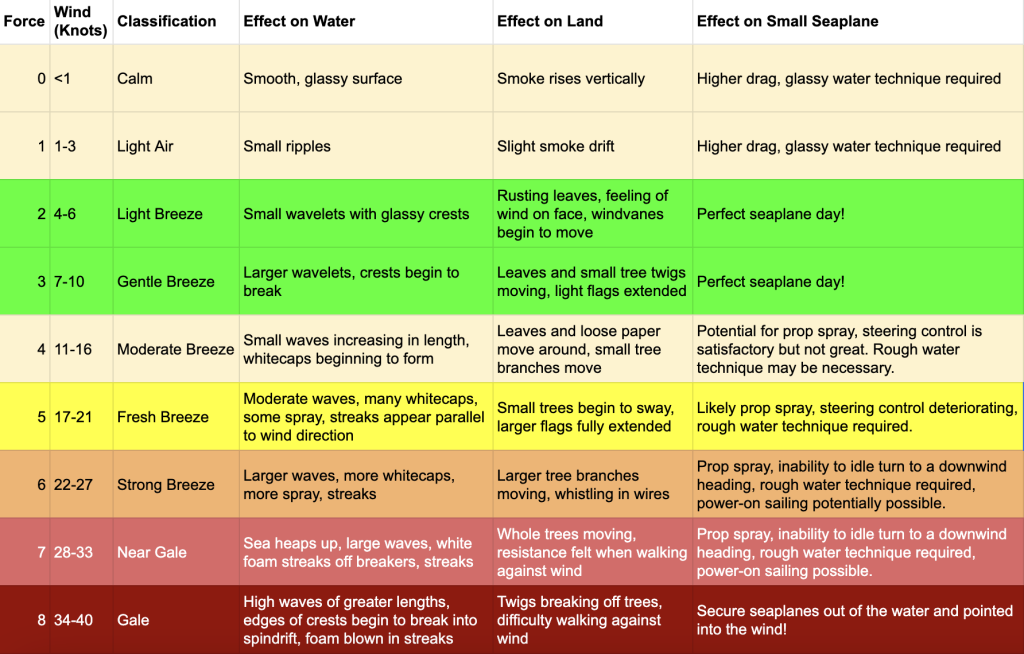
A helpful trick to determine wind and wave conditions is to utilize the Beaufort Scale. It is not a perfect system, but it allows you to create a rough estimate of wind speeds by observing water conditions, smoke, trees swaying, and flags.
Fetch
Waves build like a snowball rolling down a hill, gathering mass along the way. Fetch is the uninterrupted distance wind blows across the water, generating waves. That is why a larger lake may experience whitecaps at a windspeed of ~12 knots, while a small puddle will remain largely undisturbed even during a violent storm. Fetch is an important factor when planning a flight and determining where to land. For example, the waves at your departure point may be significantly less than your destination, even if the wind is the same velocity. Fetch is one reason why we say rough water is never uniform. While the waves in one part of the lake may be too large to land safely, continuing a mile or two upwind may dramatically reduce their size.
Boat Wakes
Another factor which may create isolated areas of rough water is boat wakes. Boat wakes come in a variety of heights and lengths, potentially creating a significant hazard for takeoff and landing. In general, they have a longer wavelength than wind waves, resulting in the pitch oscillation instability described in the article intro. Additionally, they may be difficult to spot on windy days. Boat wakes may often appear to be small and inconsequential, only for you to discover their true power upon touchdown.
Engine Run-Up
Completing an engine run-up in rough water conditions can result in significant spray damage to the propeller. Consider completing your run-up in a more protected area before taxiing out for takeoff. If that is not an option, your new priority is to complete the run-up as quickly as possible. For beginner pilots, or pilots flying a new aircraft type, practice your run-up flow beforehand so you are ready to complete it expeditiously. If you have ever had a bad magneto or fouled plugs, you know how quickly it can be identified. I can tell within one or two seconds whether the magneto passed or failed the test. Fixating on the RPM or manifold pressure gauge will only cause you to prolong the run-up, increasing propeller damage.
Taking Off in Rough Water
One benefit of rough water is that it usually shortens the takeoff run considerably. With rough water there is less drag, as there is more room for air between the floats and the water. Additionally, there is likely higher winds, helping you generate lift. Finally, the waves themselves are like small jumps, lifting the plane up and onto the step sooner. If the water is so rough that there are pitch oscillations, add takeoff power as the nose begins an up-swing. This will reduce the likelihood of burying the bows and spraying water into the prop. The aircraft will be ready to be lowered onto the step much sooner, so there will be no distinguishable ‘second rise’. As you gain speed, focus on maintaining the pitch attitude in the sweet spot, resisting the urge to rotate early. When you feel like the aircraft has enough energy to fly, you can rotate slightly to ‘peel’ it off the water surface. Alternatively, increase the flaps slightly to add a little bit more lift. Once you are off the water, accelerate in ground effect. It is best to maintain a pitch angle that is not too flat, so if you touch down again you do so in the proper attitude.
As mentioned previously, however, rough water is not uniform. In fact, you may be taking off in rather calm water and find yourself approaching a large wake at high speeds. In this case, you must switch to the rough water takeoff technique. As you contact the beginning of the wake, it may be enough of a ‘jump’ to throw you in the air, expediting your takeoff. This can be a good thing, as long as you maintain a proper ground effect attitude. More likely, though, you will be thrown in the air, only to return to the water a second later. This is why it is critical for your ground effect attitude to be slightly nose up – an attitude which would be appropriate for landing in the given water conditions. Establish a pitch attitude that prevents a stall, while also allowing you to accelerate. Even if you touch the water again, the energy you gained from being airborne should aid in the eventual full takeoff.
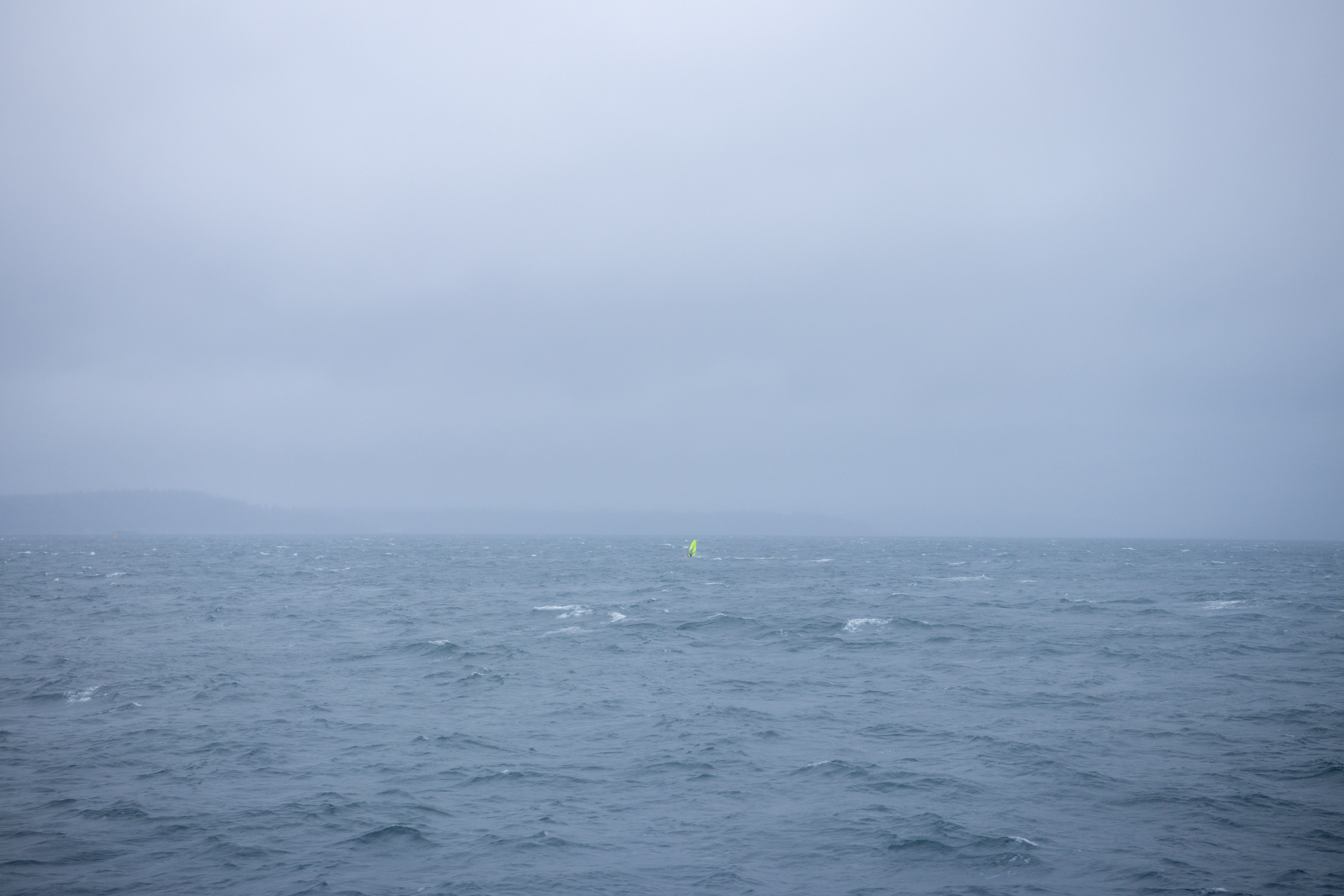
Landing in Rough Water
After assessing the water conditions using the techniques described at the beginning of this article, you are now ready to land in rough water. The aircraft is flying at an altitude of about 5 feet, in a slightly flatter, yet still nose-up, attitude. Approach this landing with a higher flap setting to get as slow as possible. Use a considerable amount of power to keep the aircraft from climbing or descending, air-taxiing down the waterbody. The further you get, the calmer the water (assuming the rough water is caused by wind). Eventually, the water will be calm enough to allow for a smooth landing. When this occurs, smoothly reduce power to allow the floats to kiss the wave crests. Upon contacting the waves, reduce the power to idle quickly to minimize the abuse on your aircraft’s structure. The longer you’re on the step, the more harmful shakes and slams you will receive.
Just like on takeoff, you may be setting up for a perfectly normal landing, only to be surprised by rough water. Boat wakes can be sneaky and blend in to wind waves. The best way to avoid a boat wake is to anticipate its presence. Do you see a large vessel moving? Trace back from the vessel to determine where the wake will go. Utilize this information to plan for your landing and the subsequent takeoff. In a lake that has criss-crossing wakes from every direction, apply normal rough water technique and keep flying until you find water that is calm enough to allow for a safe landing.
Leave a Reply